


First recorded in the UK by the herbalist John Gerard in the 16th Century, it is not clear if this plant is native to the UK or possibly introduced by the Romans. What is clear however is that the flowers once graced our meadows in such abundance that bunches were collected from beside the Thames and sold at Covent Garden Market.
Snakeshead Fritillary Fritillaria meleagris is a herbaceous perennial of the Liliaceae family native throughout Northern Europe across to Western Siberia. The UK species was possibly isolated from the European population when Britain was cut off by the last glacial period. It was mostly common to the East and South East of the UK and Oxfordshire in particular. The purple, pink and white chequered flowers used to grace our riversides and wet meadows but are now rarely seen in the wild. Draining of wetlands for agricultural purposes and the huge loss of wildflower meadows has depleted their natural habitat, and that which remains is often poorly managed and unsuitable for the delicate flowers to survive. F.meleagris is now classed as having ‘vulnerable’ status on the Red Data List.
Whether this plant is essentially native or not, it relies on bee pollination (called melittophily I found out today!) and to do this it secretes nectar with a high sugar concentration attractive to several bee species. Couple this with the fact that there was no threat to its’ existence 500 years ago makes me for one inspired to try and re-establish colonies to increase biodiversity which I think is essential to the bee immune system as much as a varied healthy diet is important to our own. Also the sight of these unusual bell-shaped nodding heads appearing about now in the wild looking just like snake’s heads mostly in a gorgeous shade of purple is pleasure indeed.
The unusual chequered pattern on the petals is possibly the reason behind the name fritillaria, deriving from the Latin ‘fritillus’ meaning dice-box. ‘Meleagris’ means ‘spotted like a guinea fowl’ and seems appropriate. The spring flowers may be solitary or in racemes and grow to a height of approximately 30cm. Narrow grey/green leaves support the emerging buds and the arching bell shape of the flower supports it’s reproductive parts. After pollination the stem straightens to hold the mature seed pod upright enabling seeds to scatter as far as possible in the wind.
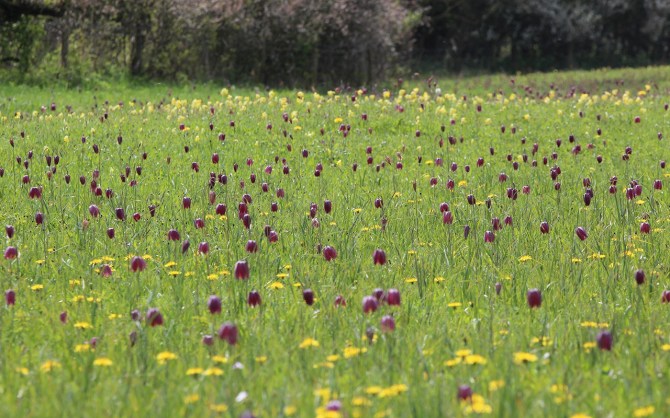
As with most bulbs the leaves need 5-6 weeks to photosynthesise and build up reserves after flowering; cutting or grazing of meadows can prevent this happening and bulbs will then deteriorate. Under deciduous trees is an ideal location as the plants get the spring light but shade in the summer months to avoid the bulbs drying out. Planting at a depth of up to 15cm also helps the plants to access sufficient moisture and to avoid being baked by the sun. F. meleagris should be no more difficult to grow than the common bluebell and in theory meadows such as that at Magdalen College, Oxford as pictured below could become a more common sight if we seek to conserve and manage some of our wetlands with due care.
 Chrissy's Cottage Garden