Monthly Archives: March 2017
Plant of the Month – Snake’s Head Fritillary


First recorded in the UK by the herbalist John Gerard in the 16th Century, it is not clear if this plant is native to the UK or possibly introduced by the Romans. What is clear however is that the flowers once graced our meadows in such abundance that bunches were collected from beside the Thames and sold at Covent Garden Market.
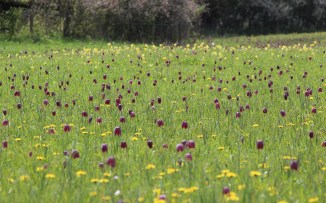
Snakeshead Fritillary Fritillaria meleagris is a herbaceous perennial of the Liliaceae family native throughout Northern Europe across to Western Siberia. The UK species was possibly isolated from the European population when Britain was cut off by the last glacial period. It was mostly common to the East and South East of the UK and Oxfordshire in particular. The purple, pink and white chequered flowers used to grace our riversides and wet meadows but are now rarely seen in the wild. Draining of wetlands for agricultural purposes and the huge loss of wildflower meadows has depleted their natural habitat, and that which remains is often poorly managed and unsuitable for the delicate flowers to survive. F.meleagris is now classed as having ‘vulnerable’ status on the Red Data List.
Whether this plant is essentially native or not, it relies on bee pollination (called melittophily I found out today!) and to do this it secretes nectar with a high sugar concentration attractive to several bee species. Couple this with the fact that there was no threat to its’ existence 500 years ago makes me for one inspired to try and re-establish colonies to increase biodiversity which I think is essential to the bee immune system as much as a varied healthy diet is important to our own. Also the sight of these unusual bell-shaped nodding heads appearing about now in the wild looking just like snake’s heads mostly in a gorgeous shade of purple is pleasure indeed.
The unusual chequered pattern on the petals is possibly the reason behind the name fritillaria, deriving from the Latin ‘fritillus’ meaning dice-box. ‘Meleagris’ means ‘spotted like a guinea fowl’ and seems appropriate. The spring flowers may be solitary or in racemes and grow to a height of approximately 30cm. Narrow grey/green leaves support the emerging buds and the arching bell shape of the flower supports it’s reproductive parts. After pollination the stem straightens to hold the mature seed pod upright enabling seeds to scatter as far as possible in the wind.
As with most bulbs the leaves need 5-6 weeks to photosynthesise and build up reserves after flowering; cutting or grazing of meadows can prevent this happening and bulbs will then deteriorate. Under deciduous trees is an ideal location as the plants get the spring light but shade in the summer months to avoid the bulbs drying out. Planting at a depth of up to 15cm also helps the plants to access sufficient moisture and to avoid being baked by the sun. F. meleagris should be no more difficult to grow than the common bluebell and in theory meadows such as that at Magdalen College, Oxford as pictured below could become a more common sight if we seek to conserve and manage some of our wetlands with due care.
Beware of the vine weevil
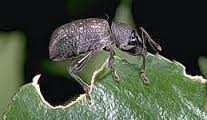
Although considered to be one of the most common plant pests I had never come across the vine weevil Otiorynchus sulcata ………… until now. Recently I had developed a small collection of Flaming Katie Kalanchoe blossfeldiana in various colours which have been in the conservatory over winter and have stood in the garden in pots in the summer. They have not been my top priority in terms of care but I had noticed that some of them were not thriving and had put this down to mealy bug or lack of water and tried to rectify this by standing them outdoors. They have all been back indoors for the winter where some have just continued to deteriorate to the point at which on touching the plants pieces have fallen off due to the stem bases having withered away. On tipping these plants out to see if anything could be salvaged the problem was immediately evident – the roots were all but eaten away and there in the soil were the instantly recognisable larvae of the vine weevil at various stages of metamorphosing into the beetle-like adult form.


They were recognisable not because I have ever had a problem with them before but because as a horticultural student I had learnt the importance of identifying them. As adults in the summer months they cause leaf damage as to a variety of pot-grown plants by feeding on the leaf margins and as such they are a particular pest to nursery growers. They feed for 3-4 weeks before laying up to 500 eggs on the soil surface which are invisible to the naked eye. These hatch after 10-14 days into the larvae which cause the most damage living within the pots from summer until the following spring and feeding on plant roots, invisibly stripping the plant of it’s life force.
However, nature being as resilient as it is, despite the loss of all the lower roots and decaying of the main stem the plants were putting out new roots closer to the soil surface. By cutting off the dead tissue and repotting these plantlets in fresh compost I am hoping that they can and will regenerate.


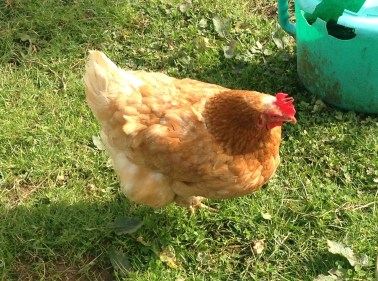
So beware of the vine weevil in the summer months, look out for semi-circular feeding on leaf margins particularly on pot-grown plants indoors and out, and remove the pest if you see it. The adult is nocturnal so scrutiny by torchlight might be necessary! The fact they are dull black in colour doesn’t help but as they are flightless they might be found in or around the plants by day. Look for these 10mm beetle like weevils particularly on rhododendron, azalea, euonymus and strawberries. (Be especially vigilant around plants that are new arrivals, my kalanchoe were a supermarket bargain!) Encourage natural enemies as birds, frogs, toads, shrews, hedgehogs and predatory ground beetles all feed on the vine weevil. This will prevent eggs from being laid which develop into the larvae that burrow into the soil and can potentially devastate a crop. Interestingly the adult is able to ‘play dead’ for up to 5 minutes to deter predators, not so of the larvae though as the chickens relished these.
Plant of the Month – Helleborus

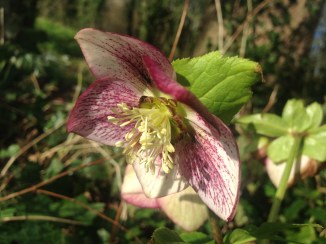 H.orientalis
This is a favourite plant of mine for several reasons – the way the large, bowing saucer-like blooms can appear within neglected areas, forgotten until their dusky pink, white and mauve shades mark the end of the dull winter months; these multiple flowering heads then remain for weeks rather than days, and the variety of species means that flowers can be enjoyed from Christmas until early spring. Not only this but hellebores are frost-resistant, tolerant of shade and drought and not particularly susceptible to disease or predation.
Helleborus is an evergreen perennnial plant of the buttercup family Ranunculaceae native to Europe and Asia, where it grows wild in meadows with the greatest natural population being in the Balkan states. Although now known as a toxic plant, the roots do not contain the cardiotoxic compounds which account for its’ potentially lethal reputation. The roots are filled with alkaloid toxins which…
View original post 407 more words
 Chrissy's Cottage Garden