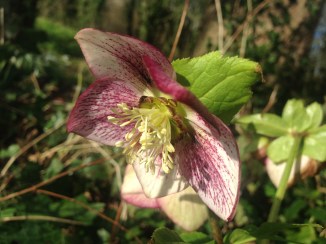
H.orientalis
This is a favourite plant of mine for several reasons – the way the large, bowing saucer-like blooms can appear within neglected areas, forgotten until their dusky pink, white and mauve shades mark the end of the dull winter months; these multiple flowering heads then remain for weeks rather than days, and the variety of species means that flowers can be enjoyed from Christmas until early spring. Not only this but hellebores are frost-resistant, tolerant of shade and drought and not particularly susceptible to disease or predation.
Helleborus is an evergreen perennnial plant of the buttercup family Ranunculaceae native to Europe and Asia, where it grows wild in meadows with the greatest natural population being in the Balkan states. Although now known as a toxic plant, the roots do not contain the cardiotoxic compounds which account for its’ potentially lethal reputation. The roots are filled with alkaloid toxins which can be a poison, or a purgative to expel poison as they are strongly emetic. The risk of fatality in the wrong dose means they have no place in modern medicine* but H.officinalis, the black hellebore, was originally cultivated by the Greeks and used for the treatment of paralysis, gout and insanity. It is mentioned in the 1st Century AD in Diosciorides ‘de Materia Medica’ as ‘melampodium’, a name derived from the goatherd Melampus who apparently used it to purge his daughter of madness. Here our ancestors used a concoction of the root to expel worms in children, but who knows how many children may have been poisoned to death in the process. There is perhaps a hint in the name which derives from the Greek ‘elein’ to injure, and ‘bora’ meaning food.
It is this black hellebore that we now commonly know as H.niger which in fact bears white flowers but is thus named for it’s black roots. It is the earliest flowering species appearing around Christmas time and as such popularly named the ‘Christmas Rose’. The Lenten Rose H.orientalis is native to Eastern Europe and Western Asia, growing wild in deciduous woodland on lower mountain slopes. It is easier to grow than H.niger and flowers between February and April in colours ranging from white, green, pink, red, mauves and purple to black, often marked or spotted with other colours. There are countless sub-species occurring naturally, and hybridisation of the genus has resulted in around 20 known species in existence today.
There is a National Hellebore Collection at Hazles Cross Farm Nursery in Staffordshire but for those who live a little bit closer to me I’m aiming on visiting Bosvigo Garden in Truro which opens its’ Woodland Walk next month where you can view the hellebores, amongst other flowering plants. Bosvigo holds a very popular’Special Hellebore Day’ in February (last Saturday unfortunately) selling plants from their collection, all in a very good cause too.
Hellebores are easy to germinate from seed and grow best in a shady humus-rich spot where once established they require very little attention. They are not surprisingly often found in alkaline soils but will adapt to acid, mine as pictured here grow well under deciduous trees where they seem to flourish with the shade and the leaf mulch.


*Reference can be found to the use of helleborus in homeopathic medicine, interesting to read but not a plant to be used without expert advice.
 Chrissy's Cottage Garden