

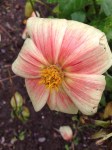
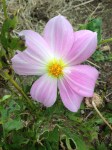
Food for thought – Dahlia yams

Originally brought to the UK as yams the  Dahlia has only by chance become the spectacle of garden borders that it is today. It is thought to have been one of the first vegetables cultivated by man around 10,000 years ago  as  ease of cultivation would have made them a good food source.  The taste appears to vary according to the the cultivar selected but has been likened to the potato, sweet potato and Jerusalem Artichoke.  The fact that they became almost predominantly grown as a garden flower would imply that other tuberous vegetables were preferred but their blight resistance meant that they almost superseded the potato in popularity during the Irish potato famine.  Food for thought when considering climate change and global food demand.

Dahlia flowers produce abundant seed which germinates easily at low temperatures.  Alternatively new plants can be successfully grown by dividing existing tubers but ensure  that each new division has a piece of stem with swollen tuber attached.  Cuttings can also be taken and planted out once rooted and the ground has warmed up.  Although the plants need some bright sunshine they will tolerate semi-shade, otherwise they are not fussy as to soil type or location provided there is sufficient drainage.  They do not like to dry out and will benefit from the addition of organic matter when planting out or a liquid fertiliser during the growing season.  This will either enhance the display of flowers or, if food is the objective, produce larger and tastier tubers which can be dug up in the autumn when the first frosts blacken the leaves of the plant.  Removing the buds as they appear will also enable energy to go into the tubers rather than the flowering parts of the plant.

Depending on the variety dahlias can grow quite tall and may need staking if exposed to windy weather.  Young plants also need to be protected from slugs if conditions are damp; iron phosphate pellets (Neudorff) are now widely available  as an environmentally-friendly alternative to chemical molluscicides.

James Wong has some great recipes ranging from plain roasting to soups to ice cream which probably add the taste that was missing when these tubers were first brought to the UK for consumption in the 1700’s.  Beware of his recommendation also to only eat tubers newly harvested from your crop as garden centre tubers will have been dried and chemically treated.  Yams will last up to a month in a cool dark place.  Refrigeration causes the tubers to deteriorate so best policy would appear to be to try out some recipes and then freeze (ideal if you’ve made ‘Roast Dahlia Ice Cream).

Finally through cross-pollination and hybridisation there is a vast range of bright, beautiful and geometrically amazing dahlia flowers to enjoy.  The National Dahlia Collection at Varfell near Penzance has over 1600 species and the garden is open in late summer to view them which is a spectacle indeed with St. Michael’s Mount as a backdrop. Not to mention the fact that the flowers were attracting a huge number of bees.Different flowering types produce variety in the flavour of the tubers so it is worth saving a tuber from a specific plant if it is producing a particularly edible tuber.

Seeds for sale on this website are from a mixture of plants as pictured.


Apples – Planning ahead and ‘wassailing’

As daylight slowly lengthens it is time to start thinking about what crops to grow but it is just as important to think about harvesting and how to maximise the yield, avoid wastage and how the harvest can be stored.  Apples are one such crop that often goes to waste and even with a range of apple varieties maturing at different times there is still likely to be a large proportion of the crop which cannot be utilised at the point of maturity and careful storage still only allows for weeks rather than months before the likelihood that fruit will perish.
Initially when we began to get a large harvest we pressed the apples into cider and for cider lovers the different varieties produced some fine beverage.  However we ended up with more cider than we could either drink or sell so  for the last couple of years we have converted the apples mainly to  juice along with a small amount of cider.  The pure juice will store for 2-3 days in the fridge or can be pasteurised at 75C but our attempt at this was not always successful and we ended up with a lot of bottles that were undrinkable.  We found the best solution was to invest in plastic freezer containers (do not store in glass bottles as we tried this and expansion of the liquid during freezing results in broken bottles) and the freshly pressed apple juice goes straight in to the freezer, there is no wastage, and we have a supply for as long as it lasts.   Now the whole family gain from not only having a delicious drink but also the health benefits of getting one of your 5 a day as well as an immune system boost in the winter months.
So if you have an apple tree or two that produces well and fruit has been going to waste it is worth investing in a press, or if you don’t have the facility and live nearby join in with our pressing in the autumn.
Meanwhile if you are less concerned with science and feeling in need of cheer now that the Christmas decorations have to come down then why not embrace Twelfth Night with the ancient pagan ritual of ‘wassailing’ your apple trees.  Coming from the Anglo- Saxon term ‘was hael’ meaning ‘good health’ this tradition was carried out in the same manner as carol singers began to ‘wassail’ the home, likewise they wanted to wish their apple orchards all the best too (though obviously with selfish motives).  It doesn’t seem to matter too much what date you do this on as it was originally  Twelfth Night, being the 5th  January but then due to the introduction of the Georgian calendar it moved to 17th January, being the twelfth night after Twelfth Night.  The exact details of the ritual as with many things have been lost in time (as well as cider) but the main object seems to be to feed cider to the tree roots and ‘feed’ the tree pieces of bread or toast.  The  original ‘wassail’ drink though was more than just cider but a mixture of cider/ale, spices, apples and egg yolk which was offered up for good health at Christmas.  The wassailing of the home, which became carol singing, appears to have been interpreted by country folk as a toast to the apple orchards, without the fruit of which there would be no wassail drink.
Dating back to the 8th century, the ritual is still carried out by some in our apple-growing counties and involves a wassail king and queen leading a procession to the largest apple tree in the orchard and hanging pieces of bread soaked in cider from it’s branches whilst singing something like “
Apple tree, apple tree we all come to wassail thee,
Bear this year and next year to bloom and blow,
Hat fulls, cap fulls, three cornered sacks fills…”
The general idea though is to make enough noise to ward off evil spirits who our ancestors believed were responsible for poor harvests.   Science now tells us that weather conditions and biennial cropping might be the answer to harvest reduction but we have new perils such as global warming, bee decline and invasive pests and diseases to contend with too.  But with all these things to think about it’s enough to make you don a king or queen’s outfit and get out there making as much noise as possible with your toast and cider and summon up as much good spirit as possible for what it’s worth.
Happy Wassailing!