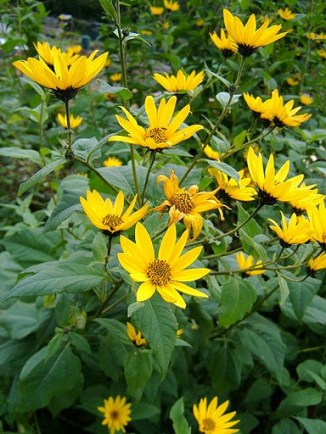
 At first glance the flowers of Helianthus tuberosus could be mistaken for a sunflower as their golden colour, height and tendency to follow the sun are features they do have in common with those better known giants of the Compositae family. However there the similarity ends as these tuber-bearing plants in my opinion have the capability to forestall famine should our trustworthy potato succumb again to blight of the magnitude that has been known in the past. The knobbly tubers may not be so easy to peel as a potato but nutritionally they are not dissimilar. Most importantly they contain the sugar inulin rather than starches or sucrose sugars which makes them suitable for diabetics.
Jerusalem artichokes are native to North America where they formed part of the diet of the American Indians. They are well-suited to growing in the UK and tubers planted in the spring will produce a crop the following autumn and throughout the winter with very little intervention as they are not particularly fussy as to soil type. location. moisture or temperature. Space is necessary as the plants grow very tall and have a rhizomous habit of spreading into adjoining ground. When flowering is finished plants can be cut down to ground level and the tubers left in situ until required, possibly with a layer of straw to cover them in case of severe frost. From my experience this is about the easiest crop to grow as the density of the plants prevents the need for weeding, tubers left in the ground will just form next year’s crop albeit without such large tubers but still a crop if time is of essence. Use in much the same way as a potato – roast it, fry it, mash it, put it in soups though trial and error may be necessary as the flavour is quite strong and perhaps not to everyone’s taste. My personal favourite is to roast the whole tubers and they become soft and caramelised in a similar way to a sweet potato. They just carry one health warning – flatulence, but hey just go for fennel tea or winter savoury is good apparently. This often ignored vegetable could just be the answer to our 21st century food needs.
s
 Chrissy's Cottage Garden